


 İnstagram
 Facebook
Real Estate Tokenization Platform Development vs Conventional Property Syndication
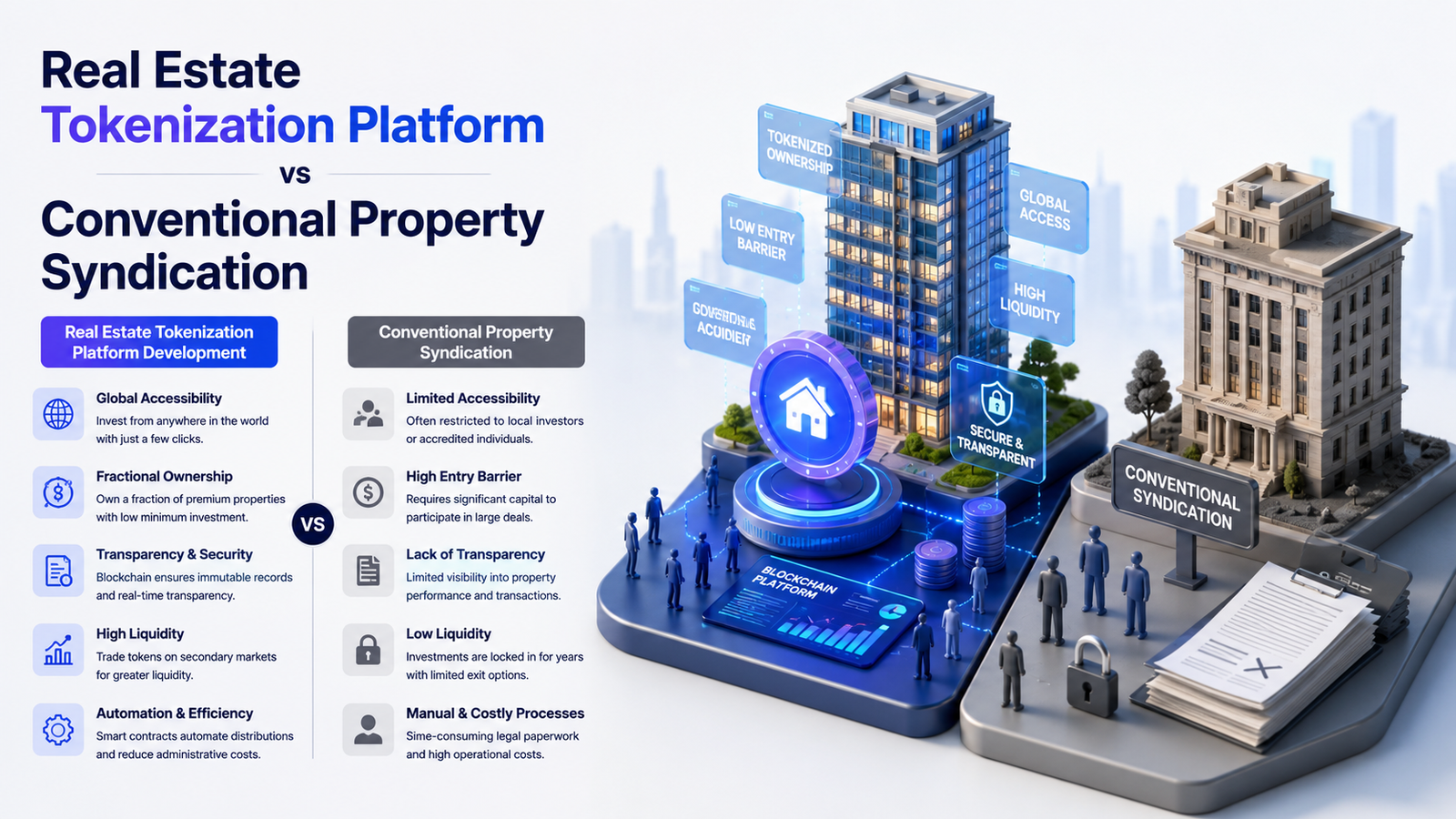
The real estate investment landscape has changed considerably over the last decade. Investors who once relied on traditional ownership structures are now evaluating digital alternatives that offer different approaches to capital formation, asset management, and investor participation. Among these developments, Real Estate Tokenization Platform Development has emerged as a notable approach for property investment, introducing blockchain-based ownership structures into a sector traditionally dominated by property syndication.
Conventional property syndication has been a widely used model for decades. It allows multiple investors to pool resources and acquire real estate assets that would otherwise be inaccessible to individual participants. While the model remains popular, it often involves extensive paperwork, lengthy onboarding procedures, limited liquidity, and restricted participation.
At the same time, Real Estate Tokenization introduces a digital framework where ownership interests in real estate assets are represented through blockchain-based tokens. These tokens can represent fractional ownership rights and may offer a different investment experience compared to conventional syndication structures.
As investors, developers, property managers, and financial institutions evaluate future investment frameworks, understanding the distinctions between these two approaches becomes increasingly important.
Understanding Conventional Property Syndication
Property syndication is an investment structure where multiple investors contribute capital to purchase and manage a real estate asset. A sponsor or syndicator identifies the property, manages acquisition processes, oversees operations, and distributes returns to investors.
This model has been used across residential complexes, commercial buildings, industrial facilities, hotels, and mixed-use developments. Investors receive ownership interests through legal agreements rather than direct ownership of the physical property.
Conventional syndication typically includes several stages:
- Property identification
- Due diligence
- Capital raising
- Investor onboarding
- Legal documentation
- Asset management
- Profit distribution
While the process is well established, it often requires substantial administrative involvement. Investors may need to review extensive documentation, complete compliance procedures, and wait significant periods before receiving returns or exiting their investments.
These limitations have encouraged the market to examine alternative structures such as real estate tokenization development.
What Is Real Estate Tokenization?
Real Estate Tokenization refers to the process of converting ownership interests in real estate assets into digital tokens recorded on a blockchain network.
Instead of issuing traditional ownership units through legal agreements alone, property interests are represented digitally. Each token may correspond to a fractional share of the asset, allowing ownership to be divided into smaller units.
For example, a commercial property valued at $10 million could be divided into thousands of tokens. Investors purchase tokens representing a portion of ownership rather than acquiring the entire property or a large syndication stake.
Real estate asset tokenization combines property ownership structures with blockchain technology, creating a digital framework for issuance, transfer, recordkeeping, and investor participation.
A Real Estate Tokenization company typically develops systems that support token issuance, investor onboarding, compliance management, smart contract integration, and asset administration.
How Real Estate Tokenization Platform Development Works
The process begins with selecting a property suitable for tokenization. Legal ownership structures are established to connect the physical asset with digital ownership representations.
A Real Estate Tokenization Development company then creates the technical infrastructure necessary for token issuance and management.
The workflow generally includes:
Asset Evaluation
Property valuation, legal verification, financial analysis, and regulatory assessment are conducted before token creation.
Ownership Structuring
Ownership rights are organized through legal entities designed to support token issuance.
Token Creation
Digital tokens representing ownership interests are generated on a blockchain network.
Investor Verification
Investors complete identity verification and compliance requirements.
Token Distribution
Approved investors purchase and receive tokens representing ownership interests.
Asset Management
Property income, maintenance expenses, and financial reporting continue throughout the investment lifecycle.
Distribution of Returns
Rental income and profits can be distributed according to token ownership percentages.
Real Estate Tokenization Services typically cover each stage of this process.
Accessibility and Investor Participation
One of the most noticeable differences between property syndication and tokenization involves investor accessibility.
Traditional syndication opportunities frequently require substantial minimum investments. Participation may be limited to accredited investors depending on jurisdictional regulations.
Property sponsors often establish minimum contributions ranging from thousands to hundreds of thousands of dollars.
Real Estate Tokenization allows ownership interests to be divided into smaller fractions. This structure may reduce capital requirements for participation, allowing a wider range of investors to access opportunities previously reserved for larger investors.
As a result, real estate tokenization development has attracted attention from property firms seeking broader investor participation.
Ownership Structure Comparison
Ownership structures differ significantly between the two models.
In conventional syndication, investors typically own shares within a legal entity such as a limited partnership or limited liability company. Ownership records are maintained through legal documentation and administrative systems.
In tokenized environments, ownership records are represented digitally through blockchain-based tokens. Transactions and ownership transfers are recorded on distributed ledgers.
This distinction changes how ownership interests are managed, transferred, and tracked over time.
While both structures ultimately represent economic rights connected to a property, the administrative methods differ considerably.
Liquidity Considerations
Liquidity remains one of the most discussed aspects of property investment.
Traditional syndication investments are often illiquid. Investors generally remain committed until a refinancing event, asset sale, or predefined exit period occurs.
This holding period may last several years.
Real Estate Tokenization introduces the possibility of secondary trading environments where ownership tokens can be exchanged among qualified investors, subject to regulatory requirements.
Although liquidity levels vary depending on market participation and regulations, tokenized ownership structures may offer additional flexibility compared to conventional syndication models.
For many investors, this represents a significant distinction between the two approaches.
Administrative Processes
Property syndication involves numerous administrative tasks.
Sponsors frequently manage:
- Investor records
- Subscription agreements
- Capital accounts
- Financial reporting
- Distribution calculations
- Compliance documentation
As investor numbers increase, administrative complexity often grows.
A Real Estate Tokenization Platform Development framework introduces digital record management and automated transaction tracking through blockchain systems.
Certain administrative activities can be managed through smart contract functionality, reducing manual processing requirements.
Real Estate Tokenization Development Services often focus heavily on these operational efficiencies.
Regulatory Considerations
Both models operate within legal and regulatory frameworks.
Property syndication structures have long-established regulations covering securities offerings, investor protections, reporting requirements, and ownership rights.
Real Estate Tokenization must comply with many of these same regulations while also addressing blockchain-related considerations.
Regulatory treatment varies across jurisdictions, making legal guidance a critical component of any tokenization initiative.
A Real Estate Tokenization company generally works alongside legal professionals to align platform operations with applicable regulations.
Compliance remains a central requirement regardless of whether investments are syndicated conventionally or tokenized digitally.
Cost Structures
Conventional syndication often involves costs associated with:
- Legal documentation
- Investor onboarding
- Administration
- Accounting
- Compliance management
- Transfer processing
As investor numbers increase, operational expenses can rise accordingly.
Real Estate Tokenization Platform Development introduces technology-related expenses, including blockchain infrastructure, smart contract development, cybersecurity measures, and platform maintenance.
While initial development costs may be substantial, digital management frameworks can influence long-term administrative expenses.
Investment organizations evaluate these factors based on asset size, investor volume, and operational objectives.
Geographic Reach
Traditional syndication opportunities often focus on specific geographic markets and investor networks.
Property sponsors typically raise capital through local relationships, financial advisors, and investment communities.
Real estate asset tokenization creates opportunities for broader investor participation across regions, subject to legal requirements.
Digital platforms may support investor engagement from multiple jurisdictions, potentially expanding access to capital sources.
This characteristic has attracted interest from property owners seeking alternative fundraising channels.
Transparency and Reporting Differences
Investor reporting remains an important component of real estate investing.
Conventional syndication relies on periodic reports prepared by sponsors and property managers.
Financial statements, occupancy reports, and distribution summaries are typically delivered at predetermined intervals.
Real Estate Tokenization platforms may provide more frequent access to ownership records, transaction histories, and asset-related information through digital interfaces.
Blockchain-based recordkeeping offers a different method for maintaining investment records and ownership histories.
This can simplify verification processes for investors and asset managers.
Risk Assessment
Neither approach eliminates investment risk.
Property market fluctuations, economic conditions, tenant performance, interest rates, and regulatory changes affect both models.
Conventional syndication benefits from decades of operational history and established legal frameworks.
Real Estate Tokenization introduces additional considerations, including technology risks, platform security concerns, smart contract functionality, and evolving regulatory environments.
Investors should evaluate these factors carefully before committing capital.
Risk analysis remains a critical step regardless of investment structure.
The Role of Technology in Property Investment
Technology increasingly influences property investment management.
Traditional syndication firms have adopted digital portals, online reporting systems, and automated workflows.
However, Real Estate Tokenization Platform Development places technology at the center of ownership management.
Blockchain infrastructure supports token issuance, ownership records, transaction processing, and distribution mechanisms.
As digital asset adoption grows, property firms continue evaluating how these technologies fit within broader investment strategies.
Future Outlook
The future of property investment is unlikely to be defined by a single model.
Conventional syndication continues to serve institutional investors, private equity firms, family offices, and established property sponsors effectively.
At the same time, Real Estate Tokenization is attracting developers, investors, and financial organizations seeking alternative ownership structures and broader participation opportunities.
Many industry participants anticipate coexistence rather than replacement.
Some investment firms may even combine traditional syndication frameworks with tokenized ownership models to accommodate diverse investor preferences.
As regulatory clarity expands and market familiarity increases, Real Estate Tokenization Services may become a more common component of property investment ecosystems.
Conclusion
The comparison between Real Estate Tokenization Platform Development and conventional property syndication highlights two distinct approaches to real estate investment.
Traditional syndication remains a proven structure with established legal foundations, extensive market adoption, and long-standing operational practices. It continues to attract investors seeking familiar ownership models and professionally managed real estate opportunities.
Real Estate Tokenization introduces a digital ownership framework where blockchain technology supports fractional ownership, digital recordkeeping, and alternative investment participation methods. Through real estate tokenization development, property owners gain additional options for capital formation and investor engagement.
For investors and organizations evaluating future opportunities, understanding the advantages, limitations, and operational differences of each approach is critical. Whether working with a Real Estate Tokenization Development company or participating in a conventional syndication, informed decision-making remains the foundation of successful real estate investing.

 Türkçe
 English
 Arabic
 Russian