


 İnstagram
 فيس بوك
Safe Days to Avoid Pregnancy: Myths, Facts, and Medical Advice
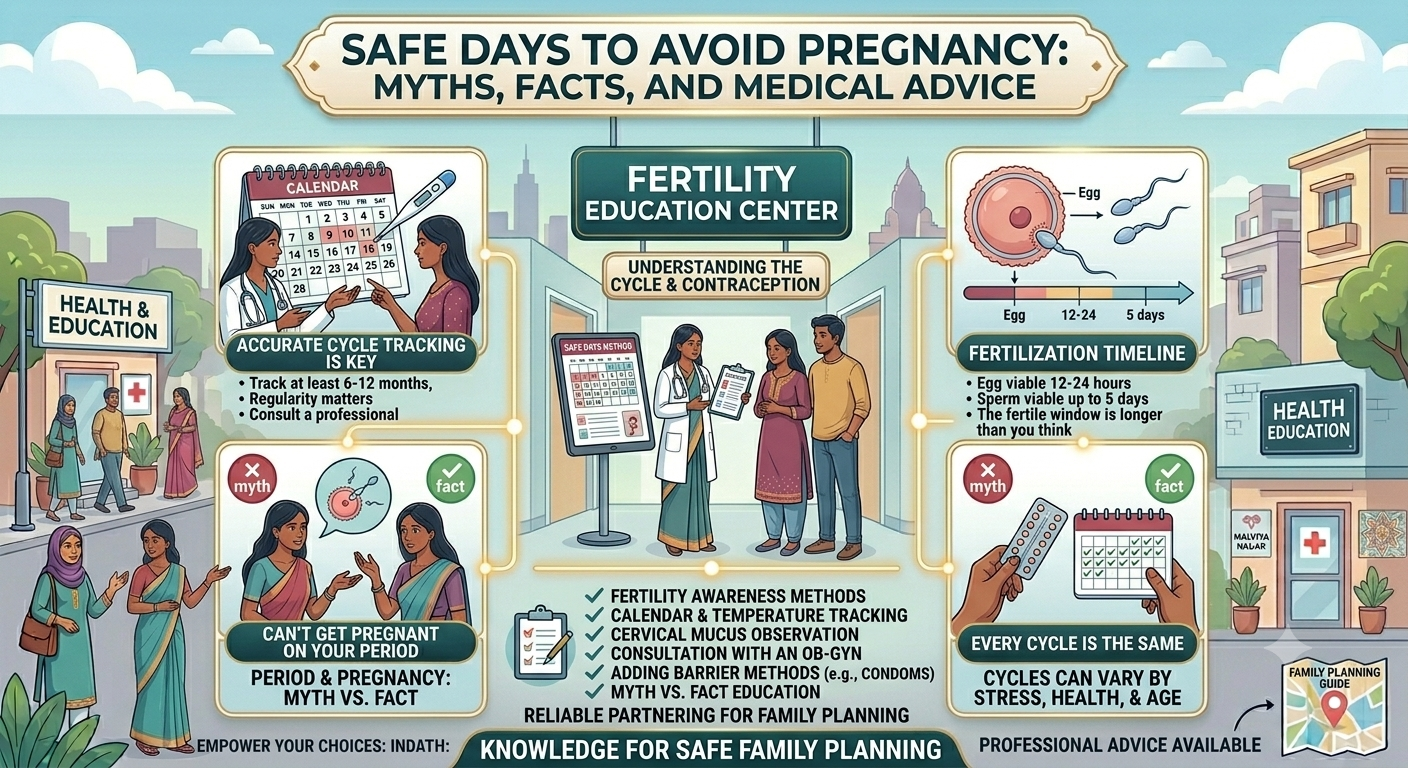
I've been in this field long enough to know that when a couple walks into my consultation room asking about "safe days," there's usually a mix of hope and anxiety behind that question. They've heard something from a friend, read something online, or maybe their grandmother told them about the rhythm method. And honestly? Most of what they've heard is either incomplete or just plain wrong.
Let me tell you what I tell every single patient who comes to me with this question: the concept of safe days isn't a myth, but the way most people understand it definitely is.
What Actually Happens in Your Body
Here's the biological reality that many people don't fully grasp. Conception isn't possible every single day of your cycle. That's just not how female reproduction works. For pregnancy to happen, you need a viable egg, and that egg only sticks around for about 12 to 24 hours after ovulation.
Sounds simple enough, right? This is where most people stop reading and start making assumptions.
But here's the catch that changes everything. Sperm can survive inside the female reproductive tract for up to five days. Yes, you read that correctly. Five whole days. So if you have intercourse on a Tuesday and you don't ovulate until Saturday, those little swimmers are still there, perfectly capable of fertilizing that egg when it finally drops.
This means your fertile window isn't just the day of ovulation. It's the five days leading up to it plus the day itself. That's a six-day window where pregnancy is absolutely possible.
The Calendar Method and Why It Fails Most People
The calendar method sounds logical. Track your cycles for a few months, find your average cycle length, and calculate when you're likely to ovulate. For someone with a textbook 28-day cycle, ovulation typically happens around day 14. So the fertile window would be days 11 through 16, and the "safe" days would be everything outside that.
On paper, it makes perfect sense.
I remember a patient from a few years ago, a young professional woman who came to see me absolutely distraught. She'd been using the calendar method for two years with no issues, and then suddenly found herself pregnant. She kept repeating, "But I was so careful. I tracked everything perfectly."
Here's what happened. Her cycle shifted by just three days that month. Maybe it was work stress, maybe it was a mild illness she didn't even notice, maybe it was travel. She ovulated on day 11 instead of day 14, and suddenly the days she thought were "safe" weren't safe at all.
When a Gynecologist in Lajpat Nagar New Delhi sees cases like this—and believe me, we see them constantly—it's a reminder that human bodies aren't machines. You can't program them to follow a calendar.
That Misleading "2 Percent Risk" Statistic
I've seen articles floating around that claim certain days of your cycle carry only a 2 percent risk of pregnancy. Maybe you've come across this too. Day 4, for instance. The logic is that your period is still happening, so there's no way you could be fertile.
Here's what I want you to understand about that number. Yes, statistically speaking, for the average woman, day 4 carries a very low risk. But averages are dangerous when applied to individuals. That 2 percent assumes you have a perfectly regular cycle and ovulate exactly when expected.
Now consider a woman with a 21-day cycle. She's ovulating around day 7. Suddenly those "safe" days right after her period aren't safe at all. I've had patients with irregular cycles or shorter cycles who conceived during what they thought was their "safe window" because they relied on generalized statistics that didn't apply to their bodies.
Statistics are useful for populations. They're not useful for you as an individual.
The Reality of Using Natural Methods
I want to be upfront about something. Fertility awareness methods are natural. They don't come with side effects. They don't require hormones or devices. In many ways, they're empowering because they help you understand your body better.
But they are not reliable contraception.
The typical failure rate for the rhythm method ranges from 8 to 25 percent. That means if 100 women use this method in a year, anywhere from 8 to 25 of them will end up with an unplanned pregnancy. Compare that to an IUD with a failure rate under 1 percent.
I'm not saying this to scare you or push you toward medical interventions. I'm saying this because I've sat across from too many women who thought they were protected when they weren't.
The problem is that ovulation is unpredictable. Stress, illness, travel, significant weight changes, and hormonal conditions like PCOS or thyroid disorders can all mess with your cycle. Even something as seemingly minor as a bad night's sleep can impact hormone levels.
I remember one patient who had used the rhythm method successfully for over a decade. Then she hit her forties, her cycles started getting shorter and more erratic, and she assumed she was less fertile because of her age. She assumed wrong. The body doesn't always follow the expected timeline.
Better Ways to Track Fertility
If you're committed to natural methods, modern tracking techniques offer much more accuracy than simply counting days.
Cervical Mucus Monitoring
Your cervical mucus changes throughout your cycle. When estrogen rises leading up to ovulation, it becomes clear, stretchy, and slippery—like raw egg whites. This is your body's way of saying "fertility is peaking." When you see this consistency, you are in your fertile window. The safe days are when the mucus is either absent, thick, or sticky.
The learning curve here is real. It takes time to learn what's normal for your body. I've had patients who initially found this confusing, but after a few months of consistent observation, they could tell exactly where they were in their cycle just by paying attention to this sign.
Basal Body Temperature Tracking
Progesterone, which rises after ovulation, causes a slight increase in your body's resting temperature—about half a degree Fahrenheit. By taking your temperature every morning before you even sit up in bed, you can confirm that ovulation has passed.
Here's the important part. This method tells you when ovulation has already happened. It's a confirmation, not a prediction. Safe days begin three days after the temperature shift. You can't use this to predict ovulation in advance.
Technology Is Changing the Game
Some newer approaches combine biological tracking with digital technology. There are devices that test saliva or other markers to detect fertility, and they sync with apps that help you interpret the results. I've seen studies on salivary progesterone-based methods showing a 96 percent effectiveness rate with typical use, which is significantly better than traditional calendar tracking.
But even with technology, the same rule applies: you have to use these methods consistently and correctly.
What I Tell My Patients
Here's the conversation I have with every patient who asks about Safe Days to Avoid Pregnancy.
If your primary goal is to avoid pregnancy, and you absolutely do not want to become pregnant right now, I would not recommend relying solely on the rhythm method. The margin for error is simply too high.
That doesn't mean fertility awareness has no place. Many couples use a combination approach. They track their cycles to identify their fertile window, and during that window they use barrier methods or abstain. Outside that window, they feel more comfortable.
I had one couple who came to me after a pregnancy scare while using the calendar method. After we had a frank discussion, they decided to track cervical mucus and temperature while also using condoms during the predicted fertile window. They felt more in control, more aware of their cycles, and more confident in their choices.
For someone with highly irregular cycles, I'm even more cautious. If you can't predict when ovulation will happen, you can't predict your safe days. In these cases, relying on natural methods is basically guesswork.
The Bottom Line
No method of contraception is 100 percent effective. That's just reality. But understanding your body and knowing your options puts you in a position to make better decisions.
The concept of safe days has some biological truth to it. There are days when pregnancy is less likely. But "less likely" isn't the same as "safe," and that distinction matters enormously.
If you're considering using fertility awareness-based methods, educate yourself thoroughly. Learn the signs, track consistently, understand the limitations. And please, have a conversation with a Gynecologist in Lajpat Nagar New Delhi or wherever you're located. Your doctor can help you understand your specific cycle, discuss your individual risk factors, and help you decide on an approach that actually fits your life and your goals.
You deserve to make decisions based on accurate information, not myths or wishful thinking. Your body deserves that too.

 Türkçe
 English
 Deutsch
 Russian