


 İnstagram
 Facebook
Why Is CPT Code 73721 Used? Prevent MRI Billing Errors Now
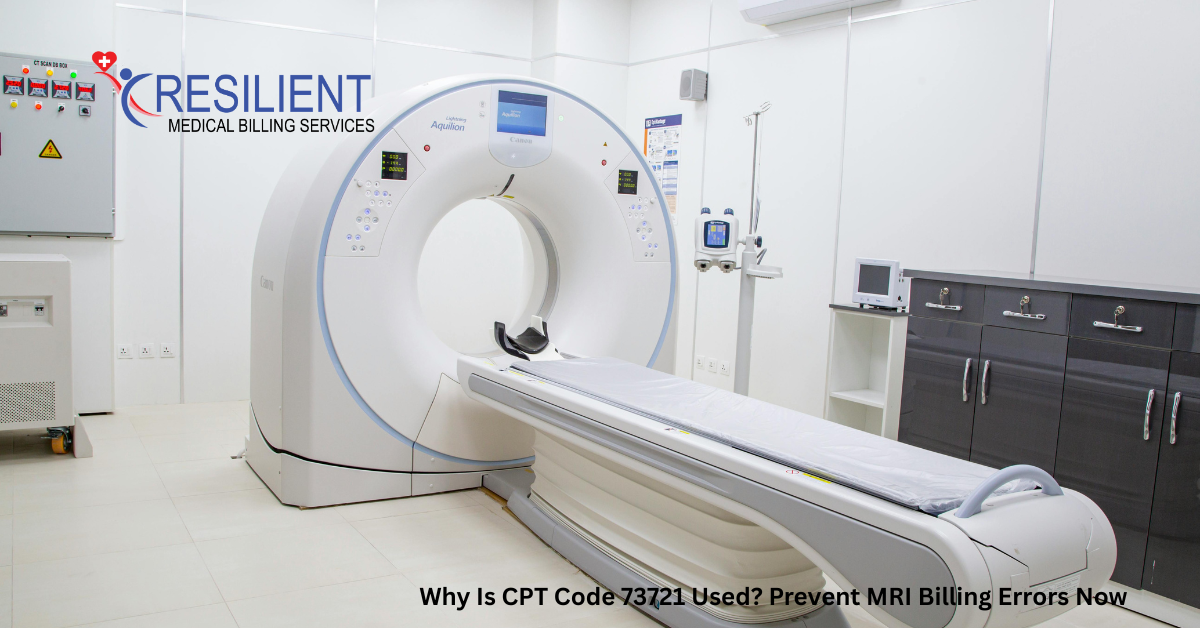
A lower-extremity MRI may be clinically routine, but a small coding mismatch can turn it into a delayed, reduced, or denied claim. Resilient MBS regularly emphasizes that successful MRI billing depends on more than selecting a familiar radiology code. The documented anatomy, use of contrast, medical necessity, authorization, diagnosis, laterality, and billed component must all support the submitted claim.
So, why is CPT code 73721 used? Resilient MBS explains that CPT 73721 is used to report magnetic resonance imaging of a lower-extremity joint when the study is performed without contrast material. It may apply to joints such as the hip, knee, or ankle, depending on the documented area examined.
The definition sounds straightforward. However, Resilient MBS knows that problems arise when the order, MRI protocol, radiology report, diagnosis, authorization, and claim do not tell the same story. Understanding the code’s limits is therefore essential for protecting CPT coding accuracy, medical billing compliance, and reimbursement.
What Does CPT Code 73721 Mean?
Resilient MBS uses CPT code 73721 when the completed service involves an MRI of a joint in the lower extremity without contrast. The code identifies three essential elements: the imaging modality is MRI, the anatomy is a lower-extremity joint, and no contrast material is used during the study.
Resilient MBS advises billers to distinguish the word “joint” from the broader lower-extremity region. An MRI focused on the knee joint may support CPT 73721, while imaging of a non-joint area, such as the thigh, calf, or another soft-tissue region, may belong to a different CPT code family. The radiology report must identify what was actually examined.
Contrast status is equally important. Resilient MBS warns that CPT 73721 should not be selected when the documented study was performed only with contrast or both without and with contrast. CPT 73722 generally represents a lower-extremity joint MRI performed with contrast, while CPT 73723 generally represents the same joint study performed without and then with contrast.
CPT 73721 at a Glance
Resilient MBS recommends confirming the following before CPT 73721 is released on a claim:
-
Resilient MBS check 1: The service was an MRI, not a CT scan, X-ray, ultrasound, or magnetic resonance angiography.
-
Resilient MBS check 2: The documented anatomy was a lower-extremity joint.
-
Resilient MBS check 3: The study was completed without contrast.
-
Resilient MBS check 4: The diagnosis and medical record support the clinical reason for the MRI.
-
Resilient MBS check 5: Any required authorization matches the procedure, body part, and side performed.
-
Resilient MBS check 6: The claim contains the correct professional, technical, global, and laterality information when applicable.
Why Is CPT Code 73721 Used in Clinical Practice?
Resilient MBS explains that MRI without contrast is often ordered when a provider needs detailed evaluation of joint structures that may not be fully assessed through standard radiographs. MRI can help evaluate bones, cartilage, ligaments, tendons, menisci, and surrounding soft tissues without exposing the patient to ionizing radiation.
Common scenarios may include suspected ligament or meniscal injury, occult fracture, internal joint derangement, cartilage damage, tendon injury near a joint, unexplained joint pain, swelling, limited range of motion, or certain degenerative changes. Resilient MBS stresses that these examples do not automatically establish coverage. The patient’s symptoms, examination findings, prior testing, treatment history, and payer policy must support medical necessity.
Consider a patient who develops persistent knee pain and instability after a twisting injury. Initial X-rays show no fracture, but the physician suspects internal derangement and orders an MRI of the right knee without contrast. Resilient MBS would expect the final report, order, authorization, diagnosis, and claim to consistently support a right lower-extremity joint MRI without contrast.
Now consider a second case in which the physician orders imaging of a suspected soft-tissue mass in the calf. Resilient MBS would not select CPT 73721 simply because the calf is part of the lower extremity. The target is not a joint, so the claim requires evaluation of the appropriate non-joint MRI code and the actual contrast protocol.
How CPT 73721 Affects Claim Reimbursement
Resilient MBS recognizes that the CPT code tells the payer what service was performed, but it does not establish coverage by itself. Reimbursement depends on the relationship between the CPT code, diagnosis, medical necessity, authorization, payer policy, provider enrollment, place of service, modifiers, documentation, and contractual terms.
A technically correct CPT 73721 claim may still be denied when the diagnosis does not support the payer’s medical-necessity criteria. Resilient MBS therefore reviews whether the documentation explains why advanced imaging was reasonable and necessary for that patient rather than relying on a vague symptom or copied diagnosis alone.
Authorization mismatches are another major risk. Resilient MBS often sees problems when an authorization covers a left knee MRI but the study is performed on the right knee, when it approves a noncontrast study but the performed protocol includes contrast, or when it lists a different imaging facility. Even when the service was clinically justified, these differences may trigger claim denials or retrospective review.
Common CPT 73721 MRI Billing Errors
1. Confusing Joint and Non-Joint MRI Codes
Resilient MBS identifies anatomy selection as one of the most preventable MRI billing errors. CPT 73721 is intended for a lower-extremity joint study. Using it for a thigh, lower leg, or other non-joint region can lead to incorrect coding, denials, recoupment risk, or inaccurate payment.
2. Reporting the Wrong Contrast Code
Resilient MBS advises billers to code from the completed procedure and final report, not merely from the original scheduling request. A planned noncontrast MRI may change after clinical review, or a scheduled contrast study may be completed without contrast. The final claim must reflect the service actually performed and documented.
3. Missing or Incorrect Laterality
Resilient MBS recommends checking whether the payer requires RT or LT and how it expects bilateral services to be reported. A payer may reject a claim when the side documented in the order, authorization, report, diagnosis, and claim is inconsistent. Bilateral billing instructions can also vary, so practices should not assume that every payer accepts the same line structure or modifier combination.
4. Incorrect Professional or Technical Component Billing
Resilient MBS explains that diagnostic imaging may include a technical component for equipment, technologist, and image acquisition, as well as a professional component for physician interpretation and report. Modifier 26 may be used when only the professional component is billed, while modifier TC may apply when only the technical component is billed. A global claim may be appropriate when the same eligible entity furnished and can bill both components under applicable rules.
5. Authorization That Does Not Match the Service
Resilient MBS recommends comparing the authorization with the actual CPT code, anatomical site, laterality, rendering facility, ordering provider, and approved date range. An authorization number alone does not guarantee payment when the approved service differs from the completed study.
6. Weak Medical-Necessity Documentation
Resilient MBS warns that a short statement such as “knee pain” may not fully explain why MRI was required. Stronger documentation may include symptom duration, injury mechanism, instability, locking, swelling, physical examination findings, prior imaging results, conservative treatment, suspected pathology, and how the results will affect management.
How to Prevent CPT 73721 Billing Errors
Verify the Order Before the Appointment
Resilient MBS recommends reviewing the order for the exact body part, joint, side, contrast status, diagnosis, ordering provider, and clinical indication. Unclear or conflicting orders should be corrected through an authorized process before the MRI is performed.
Match Prior Authorization to the Planned Study
Resilient MBS advises obtaining and validating prior authorization whenever required by the patient’s plan. Staff should document the authorization number, approved code or service, anatomical site, laterality, facility, effective dates, and any payer conditions.
Code From the Final Radiology Report
Resilient MBS encourages coding teams to compare the order and authorization with the final report. The report should identify the joint studied, side, imaging technique, contrast status, findings, and interpreting physician’s conclusion.
Apply Modifiers Carefully
Resilient MBS recommends confirming whether the claim represents the professional component, technical component, or global service. Laterality and distinct-service modifiers should only be used when supported by documentation and accepted under the payer’s current billing instructions.
Review Claim Edits Before Submission
Resilient MBS uses front-end quality checks to identify mismatched diagnosis codes, missing authorization information, invalid modifiers, duplicate units, incorrect place of service, and conflicts between the CPT code and documented anatomy. Catching these issues before submission costs far less than correcting a denial.
Compliance Considerations for CPT 73721
Resilient MBS treats CPT coding accuracy as a compliance responsibility, not merely a reimbursement tactic. Practices should report the code that most accurately describes the completed service and maintain records that support the claim. Codes should never be changed solely to obtain payment when the documentation does not support the change.
Resilient MBS also reminds healthcare organizations that HIPAA compliance applies to the handling of orders, authorization records, radiology reports, patient data, claim files, and payer correspondence. Protected health information should only be accessed, transmitted, and stored through approved systems with appropriate administrative, physical, and technical safeguards.
Payer rules can differ across Medicare, Medicaid, commercial insurance, workers’ compensation, and auto-related coverage. Resilient MBS advises practices in Texas, Virginia, and other states to confirm current payer requirements instead of relying on a single universal billing rule.
Strengthen Your MRI Revenue Cycle With Resilient MBS
One CPT 73721 error may appear minor, but repeated mistakes can create a pattern of denials, delayed cash flow, unnecessary appeals, and compliance exposure. Resilient MBS helps healthcare organizations connect documentation, authorization, coding, claim submission, denial management, and payment follow-up across the healthcare revenue cycle.
Resilient MBS supports practices that need stronger MRI billing controls, cleaner claims, better denial visibility, and more consistent coding best practices. Rather than waiting for recurring problems to reduce revenue, practices can review their workflow now and correct weaknesses before the next claim is submitted.
Take action before another avoidable MRI claim is denied. Contact Resilient MBS to learn how professional medical billing, coding review, denial management, and revenue-cycle support can help protect your reimbursements.
FAQs
What are common MRI billing errors involving CPT 73721?
Resilient MBS commonly identifies incorrect anatomy, the wrong contrast code, missing laterality, authorization mismatches, unsupported diagnoses, duplicate billing, and incorrect use of professional or technical component modifiers. A pre-submission review can catch many of these errors.
How does CPT 73721 affect claim reimbursement?
Resilient MBS explains that CPT 73721 identifies the billed MRI service, but payment also depends on medical necessity, diagnosis coding, authorization, documentation, modifiers, provider eligibility, place of service, and the payer’s reimbursement policy.
Can CPT 73721 be used for a knee MRI without contrast?
Yes. Resilient MBS notes that CPT 73721 may be appropriate for an MRI of the knee joint performed without contrast when the order, report, diagnosis, authorization, and payer requirements support the service.
What is the difference between CPT 73721 and CPT 73723?
Resilient MBS distinguishes the codes by contrast use. CPT 73721 represents a lower-extremity joint MRI without contrast, while CPT 73723 generally represents imaging performed first without contrast and then with contrast.
Does CPT 73721 require prior authorization?
Resilient MBS advises checking the patient’s specific plan because authorization requirements vary by payer, product, clinical indication, and site of service. When authorization is required, the approval should match the procedure, joint, side, facility, and date of service.

 Türkçe
 Arabic
 Deutsch
 Russian